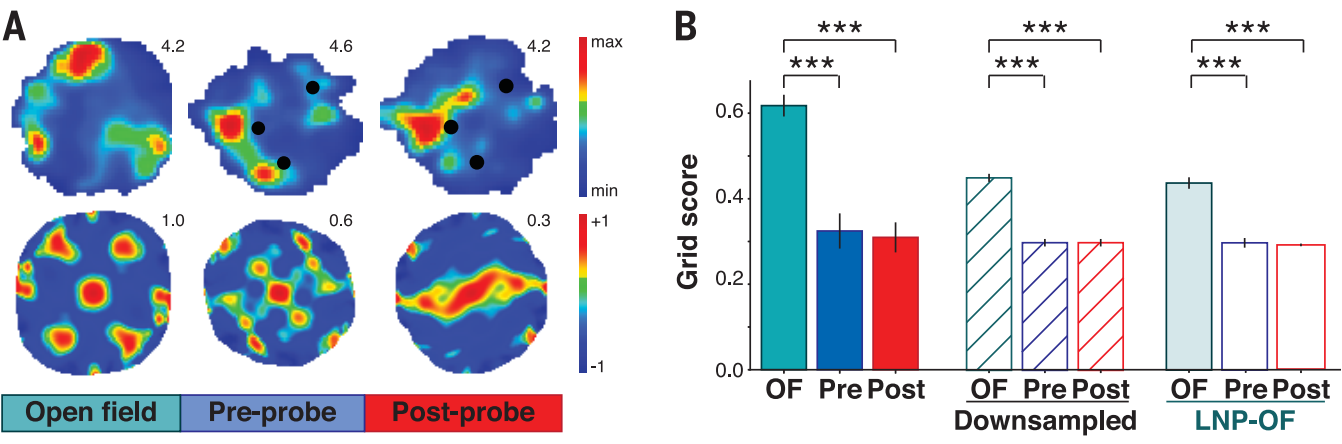
[1] Boccara, Charlotte N, Michele Nardin, Federico Stella, Joseph O’Neill, and Jozsef Csicsvari. 2019. “The Entorhinal Cognitive Map Is Attracted to Goals.” Science 363 (6434): 1443–1447. https://doi.org/10.1126/science.aav4837.
[2] Butler, William N., Kiah Hardcastle, and Lisa M. Giocomo. 2019. “Remembered Reward Locations Restructure Entorhinal Spatial Maps.” Science 363 (6434): 1447–1452. https://doi.org/10.1126/science.aav5297.
[3] Turi, G. F., Li, W.-K., Chavlis, S., Pandi, I., O’Hare, J., Priestley, J. B., Grosmark, A. D., Liao, Z., Ladow, M., Zhang, J. F., Zemelman, B. V., Poirazi, P., & Losonczy, A. (2019). Vasoactive Intestinal Polypeptide-Expressing Interneurons in the Hippocampus Support Goal-Oriented Spatial Learning. Neuron, 101(6), 1150-1165.e8.
[4] Moser, Edvard I, Emilio Kropff, and May-Britt Moser. 2008. “Place Cells, Grid Cells, and the Brain’s Spatial Representation System.” Annual Review of Neuroscience 31: 69–89. https://doi.org/10.1146/annurev.neuro.31.061307.090723.
[5] Bush, Daniel, Caswell Barry, Daniel Manson, and Neil Burgess. 2015. “Using Grid Cells for Navigation.” Neuron 87 (3): 507–520.
[6] Sarel, Ayelet, Arseny Finkelstein, Liora Las, and Nachum Ulanovsky. 2017. “Vectorial Representation of Spatial Goals in the Hippocampus of Bats.” Science 355 (6321): 176–80. https://doi.org/10.1126/science.aak9589.
[7] Cothi, W. de & Spiers, H. J. Spatial cognition: goal-vector cells in the bat hippocampus. Curr. Biol. 27, R239–R241 (2017).
[8] Hattori, Ryoma, and Takaki Komiyama. 2022. “Context-Dependent Persistency as a Coding Mechanism for Robust and Widely Distributed Value Coding.” Neuron 110 (3): 502-515.e11. https://doi.org/10.1016/J.NEURON.2021.11.001.
[9] Mussells Pires, P., Zhang, L., Parache, V. et al. Converting an allocentric goal into an egocentric steering signal. Nature626, 808–818 (2024). https://doi.org/10.1038/s41586-023-07006-3
[10] Lai, C., Tanaka, S., Harris, T. D., & Lee, A. K. (2023). Volitional activation of remote place representations with a hippocampal brain–machine interface. Science, 382(6670), 566–573. https://doi.org/10.1126/science.adh5206



 京公网安备 11010502034662号